
Quick Answer for Engineering Leaders
Manage a software project against the delivery evidence, not the color of its last status report. Keep the outcome and scope clear, watch where critical work is aging or waiting, and update the completion forecast when capacity, dependencies, or quality work change. Every review should end with a decision owner and the next point at which the team will test whether that decision helped.
An unchanged date in the weekly report can coexist with a different delivery picture. Suppose two pull requests have spent most of the week in review, and the partner integration cannot proceed until a decision is made. The next project review should establish whether those delays affect the release plan and, if they do, who can change it.
Managing software projects under those conditions is about preserving choices. The team might reassign review work, remove an optional part of the first release, or move the date, but each option depends on knowing which work is critical and which decision is late. None of this requires ranking individual developers.
For a practical software project management process, start with five questions:
- What outcome is the initiative expected to deliver, and what work is included?
- What work and delivery history support the current completion window?
- What changed since the last review, and does it affect the critical path?
- Who can decide whether to change scope, capacity, or the date?
- When will the team check whether that decision helped?
This software project management guide uses those questions to make the weekly review decision-focused.
From Status Updates to Delivery Evidence
Status Is a Summary, Not Evidence
Executives still need a short status line, and product leaders need a date for release conversations. But that line needs a reason. If the team reports green while release-critical items wait in review, the manager must know whether the wait is expected or changes the forecast.
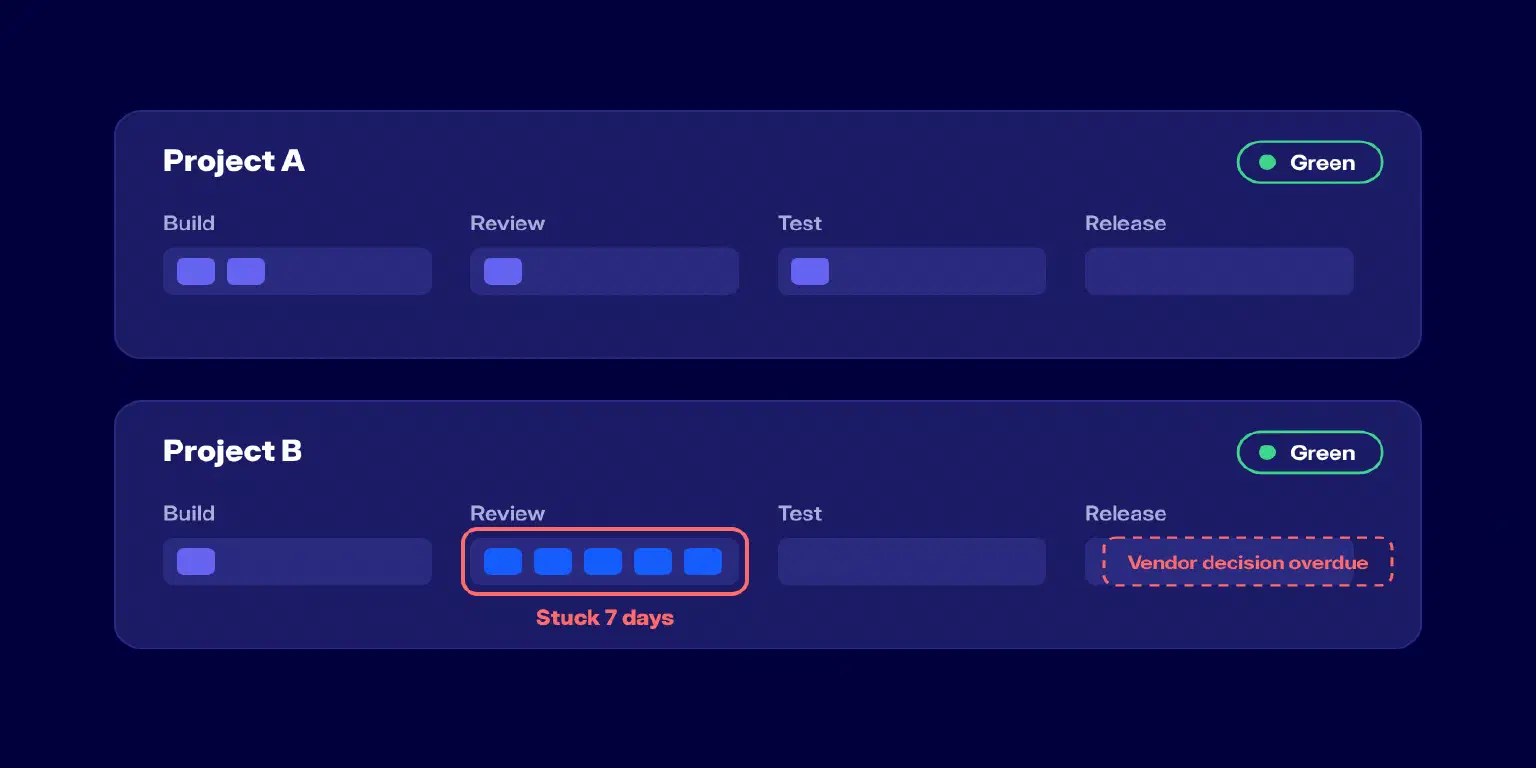
Compare two green projects. One has a stable backlog and has cleared integration testing. The other has two major items waiting for reviewers who are handling an incident; the vendor decision is overdue too. Both report the same delivery date. The second team needs to decide who can review the items and who owns the vendor decision, even before the status changes.
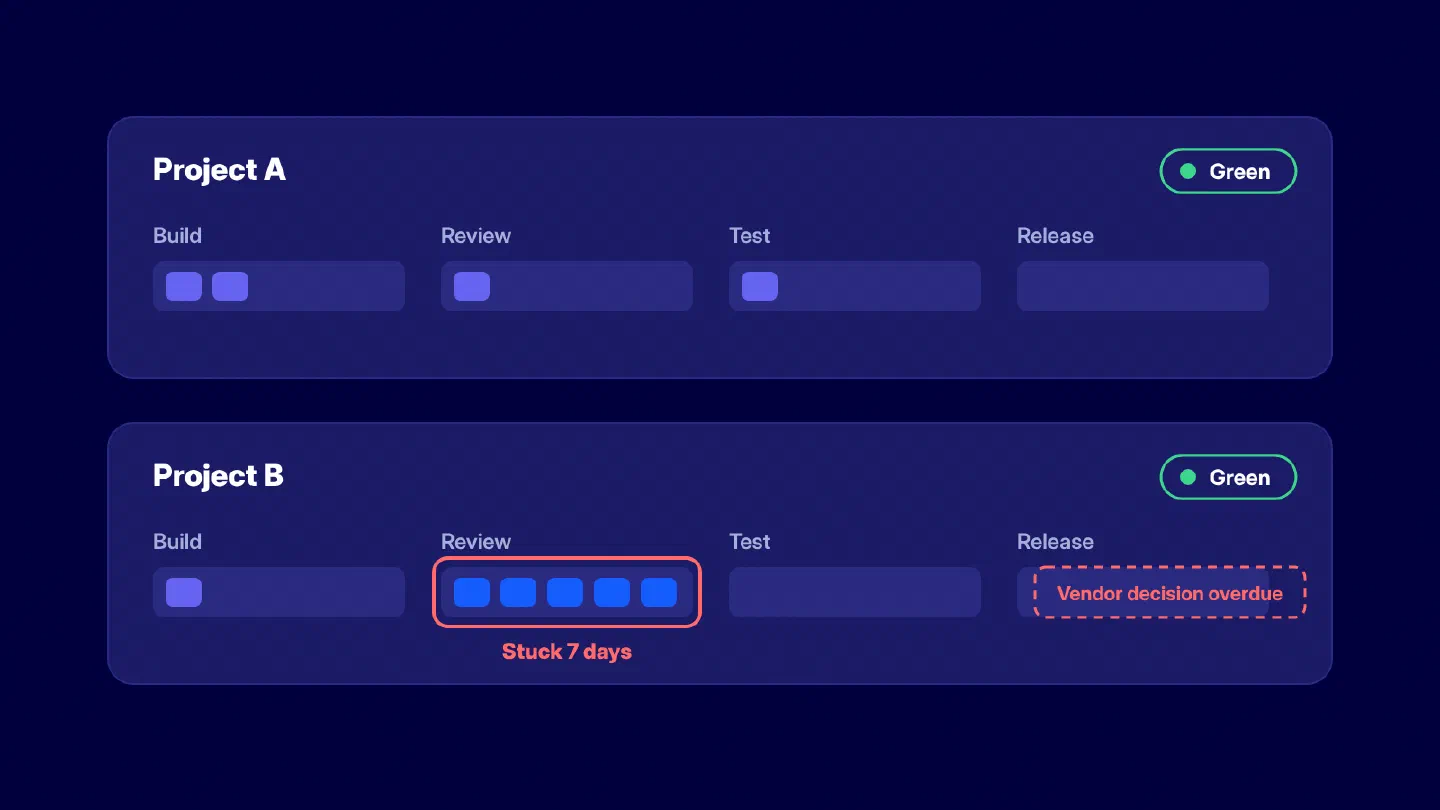
When managing software development projects, use the color after reviewing the work. The team should be able to say what changed in flow or dependencies and whether it affects the forecast. A queue does not always threaten a date, but an unexplained queue does not justify green either.
| A conventional status report | What a delivery review can examine |
|---|---|
| A project is marked green, amber, or red | Whether the forecast still fits the remaining work and open dependencies |
| The weekly summary is assembled by hand | What changed in the tracker, review queue, or delivery plan since the last review |
| A late project prompts another request for detail | Which work item or handoff is delaying the next stage |
| Stakeholders debate the color | The affected initiative, workflow stage, and decision owner |
Measurement, uncertainty, planning, and delivery come together in a software release. If remaining work grows or a vendor date moves, the forecast deserves another look even if the last status report was green.
What a Delivery Lead Must Keep Under Control
Assigning tasks will not, by itself, answer how to manage a software development project. A delivery lead needs to know what must be true for the release to happen: which outcome matters, what remains in scope, whether critical work is moving, and who can resolve a blocked handoff. In the second green project above, the issue is not whether people are busy. It is whether review capacity and the vendor decision will be available soon enough for integration and testing.
A useful project review keeps five connected areas in view:
- Outcome and scope. What result must the release produce, what work is included, and what has changed? Check acceptance criteria, backlog changes, and rework rather than treating the original plan as fixed.
- Flow and release readiness. Is critical work moving through review, testing, security, integration, and approval? Work-item age, WIP, stage time, blocked work, and throughput can reveal a constraint before a milestone is missed.
- Dependencies and risk. Which handoff or assumption could invalidate the plan? Name the provider, receiving owner, due date, and effect on the critical path.
- Capacity and cost. Is the required expertise available, and where is the effort actually going? Compare initiative allocation with review load, unplanned work, specialist constraints, and project-cost context.
- Forecast and decision rights. What completion range fits the remaining work and delivery history, and who can change scope, sequence, funding, or the commitment? Record the decision owner, escalation path, and next decision date.
A high ticket count can conceal an unresolved integration decision. It records completed activity, not release readiness.
Why Manual Status Reporting Fails Under Pressure
A manual report is good at recording decisions. It is weaker at finding what changed since the last meeting. The person writing it must reconcile the tracker, code reviews, delivery plan, and conversations with other teams; by the steering meeting, a queue may already have grown.
That delay matters when the meeting must decide whether to protect a date, change scope, or escalate a dependency. A snapshot assembled on Monday may be stale by Thursday. The program-level color can hide one aging release item, and a recovery claim such as “we will catch up next week” says little unless the team names the decision or handoff that would make recovery possible. Time spent assembling the report is time not spent finding why work stopped.
In a 2015 PMI conference paper on project decisions, J. LeRoy Ward identifies trustworthy data received at regular intervals, timely decisions under uncertainty, and governance that assigns decisions to the right level. In a software delivery review, that means opening the affected initiative and handoff while the decision makers are together.
Read Project Health in Context
Build a Data Layer Around the Delivery System
No single system holds the release story. The issue tracker shows remaining scope and blockers; the code host and CI/CD show which changes reached review and build. The vendor decision may exist only in a conversation, while an incident explains why reviewers are unavailable. To assess the date, a delivery lead needs those records connected to the same initiative.
Suppose cycle time rises in the second green project. The manager would check where the extra time accumulated and whether the affected work is needed for the release. A review queue crowded by incident response calls for a different decision from a planned security review, so the manager needs the item history and reviewer availability before changing the plan.
Through AndonPulse integrations, project-management, code-hosting, communication, and relevant HR data can be connected without asking engineers to switch tools. A delivery lead can examine the initiative, its work, and the involved teams, then choose whether review ownership, scope, or the forecast needs to change.
This matters when leaders need to know how to manage software development projects across teams. In our example, the product board may show a feature nearly complete while code review slows and the vendor decision stays open. The manager must understand the effect on integration and testing before confirming the date.
Project Health Signals That Deserve Attention
The Kanban Guide identifies four flow metrics: work in progress, throughput, work-item age, and cycle time. It defines a service level expectation separately as a probabilistic forecast for an item’s time from start to finish. Used carefully, the four measures help teams see whether work is behaving differently from its usual pattern; they are not a universal score for people or projects.
| Signal | What it may indicate | What to inspect before acting |
|---|---|---|
| An item is aging unusually | A blocker, an oversized item, missing clarification, or work waiting in a stage | The item history, current stage, blocker, and comparable work |
| WIP rises while throughput stays flat | More work has started than the system can finish | Which active items support the commitment and which starts can pause |
| Review time grows while build time is stable | Review capacity, approval policy, or work size is constraining flow | Reviewer availability, queue age, pull-request size, ownership rules |
| Work has no recent progress | The item may be waiting for a decision, dependency, or response | The last meaningful change and the person able to unblock it |
| A dependency is overdue | The handoff may now affect the critical path | Definition of ready, owner on both sides, revised handoff date |
| The forecast moves | Scope, flow, capacity, or dependencies have changed | Which assumption changed and which trade-off is available |
Throughput and cycle time are more useful together than in isolation. A team may close many small items while one complex integration waits. Likewise, a low WIP count is not automatically good if the only work in progress has been stalled for days. The manager has to interpret the signal in the context of the initiative.
Establish a Baseline Before Raising an Alarm
One team may normally complete small support items within a day. Another may work on regulated integrations that remain in review for much longer. Applying the same threshold to both creates noise and eventually teaches people to ignore alerts.
DORA’s software delivery metrics guide cautions against blending results across unlike applications. The same context-first principle applies to project alerts: establish what is normal for the workflow before calling a change a problem.
Before setting an expectation, look at how that particular team and workflow usually behave. What is a normal range for work-item age? Which stage absorbs the most waiting time? How often do external dependencies enter the flow? Are there predictable release or audit periods that alter the pattern? A baseline does not make delivery certain, but it makes a deviation more meaningful.
This distinction matters for anyone learning how to manage a software project. A single slow item can be ordinary variation. Several items aging at once, coupled with a dependency that is late and a forecast that has started to move, suggest a delivery constraint. The review should focus on the pattern rather than demand an explanation for every fluctuation.
Turn Delivery Signals Into Management Decisions
Move From a Signal to the Root Cause
Imagine an initiative that is still shown as on track. Its scope has not formally changed, but work in progress has grown for two review cycles, two critical items are older than comparable work, and code review has become slower. The first question is not who is responsible. It is where the flow changed.
Follow the evidence in this order:
- Initiative: Identify the promised outcome and delivery window. Does the signal threaten the commitment?
- Epic or project: Find the stream of work that changed. Is there work to protect, defer, or re-sequence?
- Task or pull request: Check for a blocker, rework, an oversized item, or a missing decision. Would splitting the work or clarifying acceptance help?
- Workflow stage: See whether waiting is concentrated in review, test, security, or release approval. Does ownership, policy, capacity, or batch size need to change?
- Dependency and team context: Check whether another group can complete its handoff. If not, agree a dated decision, escalate, or adjust the plan.
For example, imagine senior reviewers supporting incident response while another team waits for a contract decision before it can complete an API dependency. The best response could be to shift review ownership, reduce the first release, and set a firm dependency decision date. “Work harder” is not a project-management action.
The investigation needs to preserve that chain of context. A leader should be able to start with the initiative-level warning, inspect the related project and task, and then see the workflow stage, dependency, and team conditions that explain the delay. A dashboard that shows only the warning still leaves managers to reconstruct the cause in another meeting.
In AndonPulse, the manager can follow that same path from the at-risk initiative to the affected epic, task, and time spent in review. The connected team and dependency context helps distinguish an incident-driven review queue from the vendor handoff, so the manager can decide whether to shift review ownership, change scope, or escalate the decision. After the intervention, the delivery view and forecast can be checked again to see whether the risk is easing; the platform does not choose the intervention.
Forecast a Range, Not a Fictional Exact Date
A commitment is the date the organization has agreed to work toward. A forecast is an assessment of what is likely to happen under the current conditions. They can match, but they should not be confused.
The diagram below shows how a fixed commitment can coexist with a forecast range that changes as new evidence emerges.
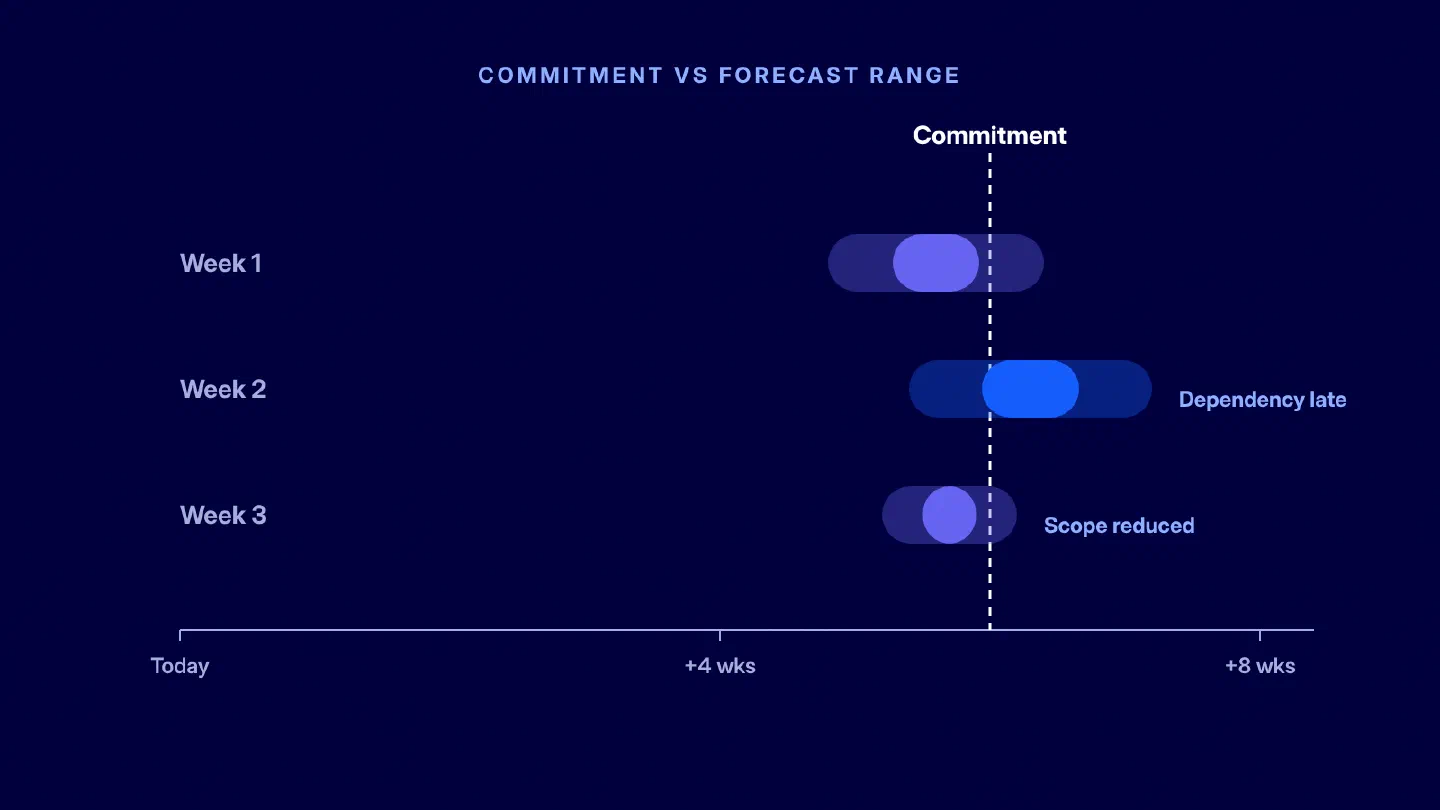
When teams ask how to manage software projects with changing conditions, the honest answer is to update the forecast as evidence changes. The review should consider completed and accepted work, remaining work, quality and integration activities, dependencies, capacity, and the assumptions that could change the result. A range is often more useful than a single date because it makes uncertainty visible rather than burying it in a green status.
| Forecast driver | Question to ask | What may change the range |
|---|---|---|
| Scope | What work remains after the latest decisions? | A new feature, a late defect, or removed work |
| Flow | How quickly is comparable work currently finishing? | Aging work, rising WIP, review delays, blocked items |
| Capacity | Is the required expertise actually available? | Incidents, leave, competing initiatives, reviewer bottlenecks |
| Dependencies | What must arrive before the next stage can finish? | Vendor dates, platform work, security or product decisions |
| Quality and release | What remains beyond implementation? | Test failures, integration readiness, approvals, release windows |
Say the condition plainly. If a date depends on receiving a security decision by Friday or excluding a lower-priority integration from the first release, stakeholders need to see that dependency. The forecast is not less useful because it contains conditions. It is more useful because it creates a choice early enough to make.
Run a Weekly Review That Produces Decisions
If the question is how to manage software projects across several teams, start the review with initiatives where something material changed and work toward a decision. Do not spend the meeting on round-robin progress speeches. The following 30-minute agenda is a reusable software project management workflow for a weekly delivery review.
| Time | Review question | Output |
|---|---|---|
| 0 to 5 minutes | Which initiatives changed materially since the last review? | Shortlist of items needing attention |
| 5 to 12 minutes | What is the evidence behind the change? | Shared view of the affected flow, scope, or dependency |
| 12 to 20 minutes | What explains it, and what remains uncertain? | A testable cause hypothesis and the next fact to verify |
| 20 to 26 minutes | What decision or trade-off is required? | Owner, action, and due date |
| 26 to 30 minutes | What does the current forecast now depend on? | Updated range or next checkpoint |
The timeline below turns the agenda into a five-step decision flow, moving from what changed to evidence, cause, decision, and an updated forecast.
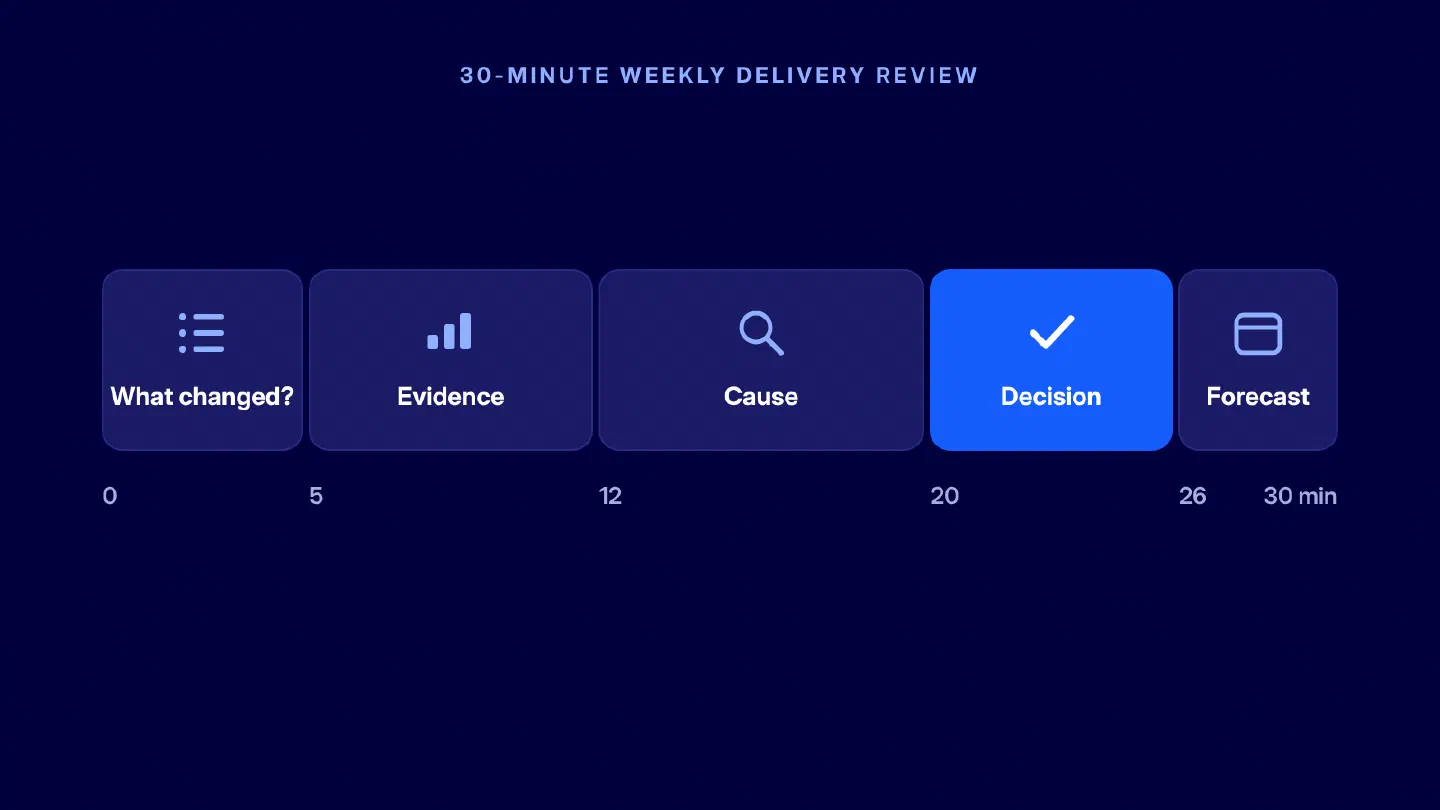
Two questions keep the meeting useful: “What changed since the last review?” and “What action can alter the outcome?” If nobody can answer the second question, the group should not disguise uncertainty as confidence. It should assign the investigation, name the owner, and set the next decision point.
That half-hour should end with a changed forecast, a named decision owner, or a dated question to resolve. Otherwise, the meeting has only refreshed the report.
Manage Dependencies, Capacity, and Cost Together
Managing software development projects across teams requires treating dependencies and capacity as related. A team can have people assigned to an initiative and still be unable to deliver because a platform team, vendor, security function, or product owner cannot complete its part of the handoff. Equally, a dependency may be ready while the receiving team is split across too many priorities.
| Situation | Evidence to bring to the review | Management response |
|---|---|---|
| A shared platform dependency is late | Blocked-work age, owner, handoff date, and effect on the critical path | Agree a new decision date, change sequence, or revise the commitment |
| A team is spread across initiatives | WIP, unfinished work, allocation, and unplanned demand | Pause lower-priority starts and protect the work tied to the commitment |
| Scope has grown after planning | Added work, displaced work, and forecast movement | Trade scope, capacity, or date explicitly |
| Review capacity is constrained | Queue size, stage time, reviewer load, and approval rules | Change ownership, reduce batch size, or adjust the review path |
For portfolio leaders managing software projects across teams, project cost context belongs in the same conversation. Planned priorities may say one initiative is strategic, while actual engineering effort shows that another has consumed the specialist capacity needed to deliver it. The review therefore needs to connect delivery, resource allocation, and project-cost context, without treating an allocation report as a substitute for an investment or accounting-policy decision.
Put the Method to Work
Compare Reported Status With Earlier Signals
Teams managing software projects do not need another generic project-health score to improve reporting. If approved historical data is available, compare 15 to 30 completed or delayed initiatives with the signals visible before their official status changed. This is a starting point for finding local patterns, not a universal threshold.
For each initiative, record the reported status, the first date at which the forecast moved, the age of critical work, dependency condition, review delay, scope changes, and the decision that followed. Then ask three questions:
- Which signals appeared before the project was formally marked at risk?
- Which signals were normal variation for this team and therefore poor alert candidates?
- Which decision could have been made earlier if the relevant context had been available?
The comparison below shows how aging work, review queues, dependencies, and forecast movement can surface risk weeks before the reported status changes.
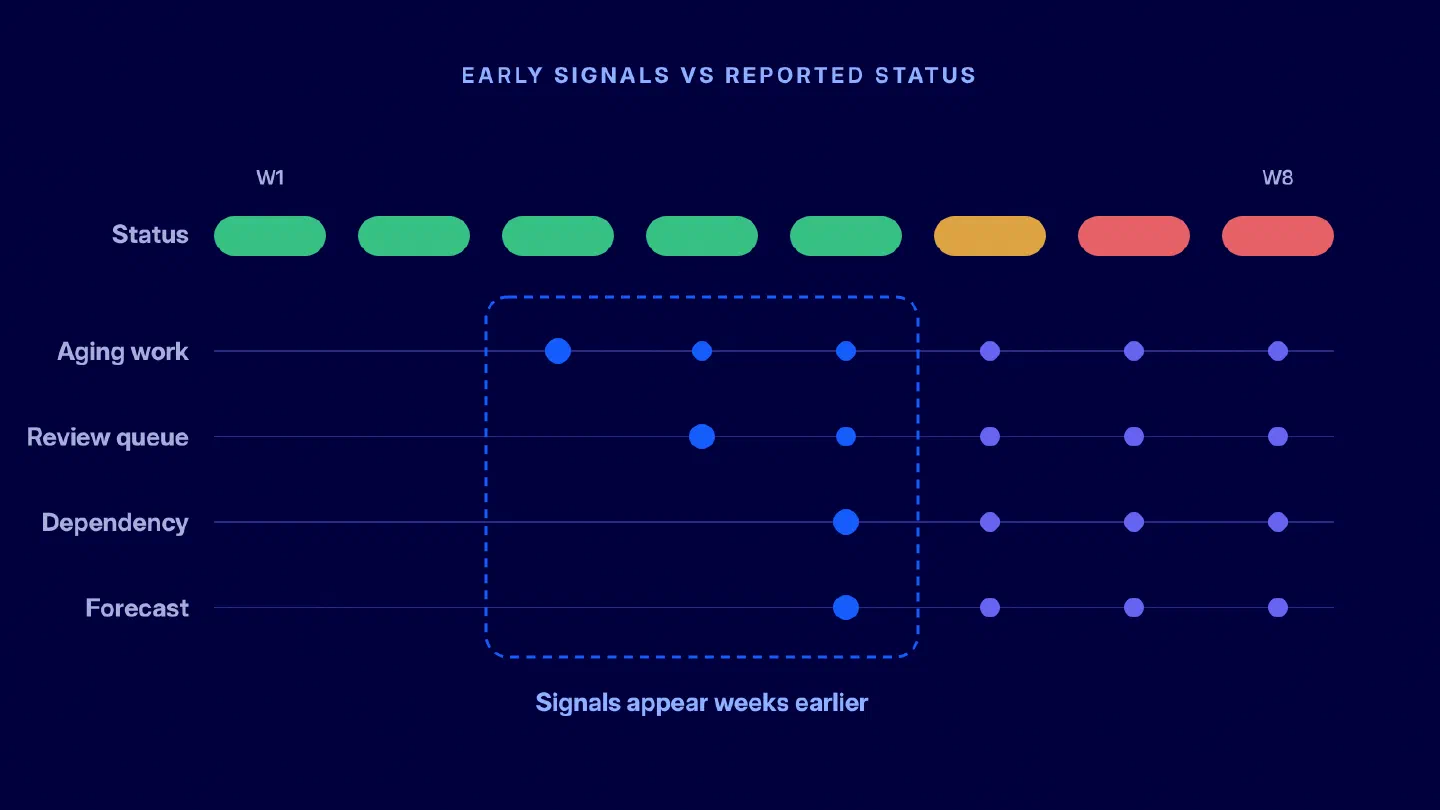
The goal is not to replace reported status, but to test it against evidence that appears earlier.
The exercise can show which early signals matter in your workflows. Aging work may be useful in one team, while late dependencies may tell another team more than an overall completion percentage. Grounding the software project management process in these patterns is more useful than relying on a generic project-health score.
How AndonPulse Supports Software Delivery Management
Return to the release delayed by code reviews and a vendor decision. The useful question is whether changing review ownership is enough to protect the first release, or whether the unresolved handoff requires a scope or date decision. AndonPulse connects the planning and engineering records behind that question in one delivery view, without asking engineers to maintain another status report. Resource-allocation and project-cost views give leaders context when a proposed capacity shift may affect another initiative.
The manager still owns the trade-off. Once the team reassigns a review, resolves the handoff, or changes the release scope, the delivery state and forecast can be reviewed against the new conditions. For software delivery management, that follow-up matters more than a dashboard that only repeats a risk label.
If your team faces a similar decision, bring one active initiative and its current blocker to a guided walkthrough and test whether the signal-to-decision path fits your workflow.
Software Project Management Checklist
Use this checklist before a weekly portfolio or project review:
- The expected outcome, scope, and release condition are clear enough to assess whether work is on track.
- Every material dependency has an owner, a definition of ready, and a known handoff date.
- The review covers work-item age, WIP, stage time, blocked work, and forecast movement in context.
- Remaining work includes quality, integration, security, approval, and release activities.
- Any scope change is linked to a capacity, sequencing, or forecast decision.
- The forecast reflects current progress and stated assumptions, rather than the original plan alone.
- The next decision, owner, and review point are recorded.
These software project management best practices do not turn every project into the same process. A platform migration, a customer feature, and an incident-response program will have different rhythms. What should remain consistent is the link between the delivery evidence, the management decision, and the next checkpoint.
Final Takeaway
Managing software projects becomes more reliable when status is anchored in the delivery system. Teams need a clear outcome and scope, but they also need to see work aging, review queues, dependency movement, capacity constraints, and the assumptions behind a forecast. That allows a manager to make a smaller correction early instead of explaining a missed date late.
FAQ
How do you manage software projects effectively?
What is a software project management workflow?
What are the most useful software project management best practices?
How do you spot a software project that is at risk?
How do you manage changing scope in a software project?
Are weekly status meetings still useful?
How do cross-team dependencies affect software delivery management?
How do you manage software development projects when priorities keep changing?
Which tools help manage software projects across teams?
How should a software project forecast be presented?
Find Out Why Your Initiative Is Slipping
Your status report says green, but something feels off. Bring that initiative to an AndonPulse demo.
We’ll walk through it with you and show:
- which tasks, reviews, or handoffs are holding it back;
- how the completion forecast compares with your commitment;
- what changes if you move reviewers, cut scope, or escalate a dependency.
AndonPulse works with the data your teams already have in Jira, GitHub, GitLab, and similar tools, so engineers keep working as usual. You leave the call knowing what is slowing the initiative and which decision to make next.