
Quick answer
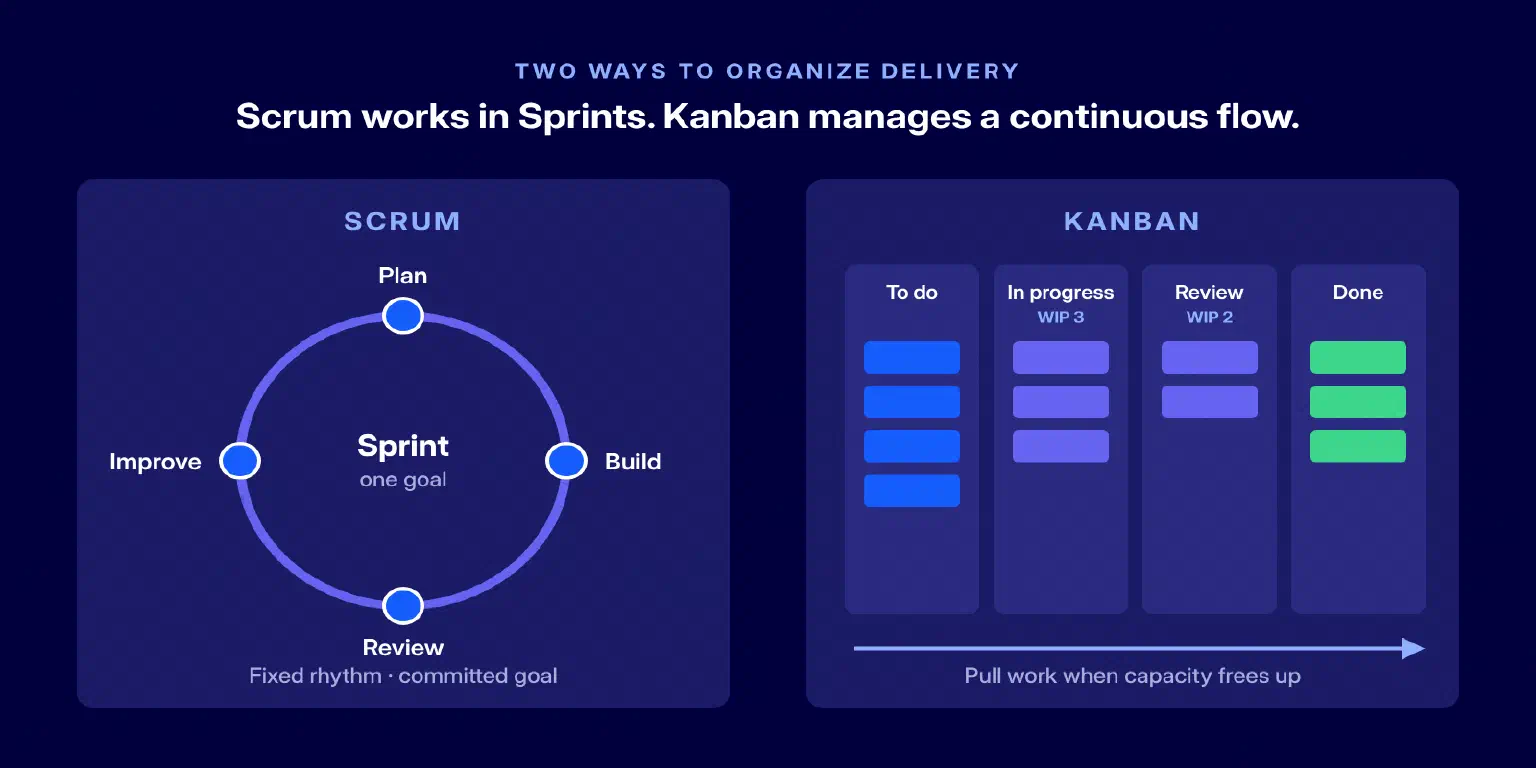
For software teams, Kanban vs Scrum is mainly a question of how work enters the system. Scrum gives a team a short period in which to pursue a product goal and review a usable result. Kanban helps it manage work that keeps arriving, with explicit rules for capacity and flow. A team building a planned product change may benefit from the first arrangement; a team handling production requests alongside project work may need the second. Look at the work that actually arrived last month, including interruptions, before choosing either one.
Start with the official definitions
The Scrum Guide calls Scrum a lightweight framework for complex work. A Product Owner orders a Product Backlog; Developers create a usable Increment during a Sprint; and the Scrum Team inspects the outcome with stakeholders before adapting. The Sprint is fixed in length at one month or less. Scrum also defines three accountabilities, five events, and commitments tied to its artifacts. Its purpose is not to turn a two-week estimate into a contract. A Sprint Goal gives the team a reason to focus, while the exact scope can be renegotiated as it learns.
The Kanban Guide defines Kanban as a strategy for optimizing the flow of value through a process. It requires a defined and visualized workflow, active management of work items, and ongoing improvement. Teams must make their start and finish points, workflow states, WIP control, movement policies, and service level expectation explicit. Kanban is therefore more than moving cards across a board. It asks whether work is aging, where queues form, and when the system has capacity to pull in the next item.
The practical difference between Scrum and Kanban is where the team puts its operating boundary. In Scrum, the Sprint Goal gives the team a near-term outcome to protect and review. In Kanban, capacity and movement policies determine when work can enter and move through the system. These are not substitutes for a product strategy or sound engineering. They are ways to make different kinds of delivery problems easier to see and manage.
Kanban vs Scrum at a glance
The visual below shows the core structural difference: Scrum organizes delivery around a fixed Sprint rhythm and goal, while Kanban manages work as a continuous pull-based flow.
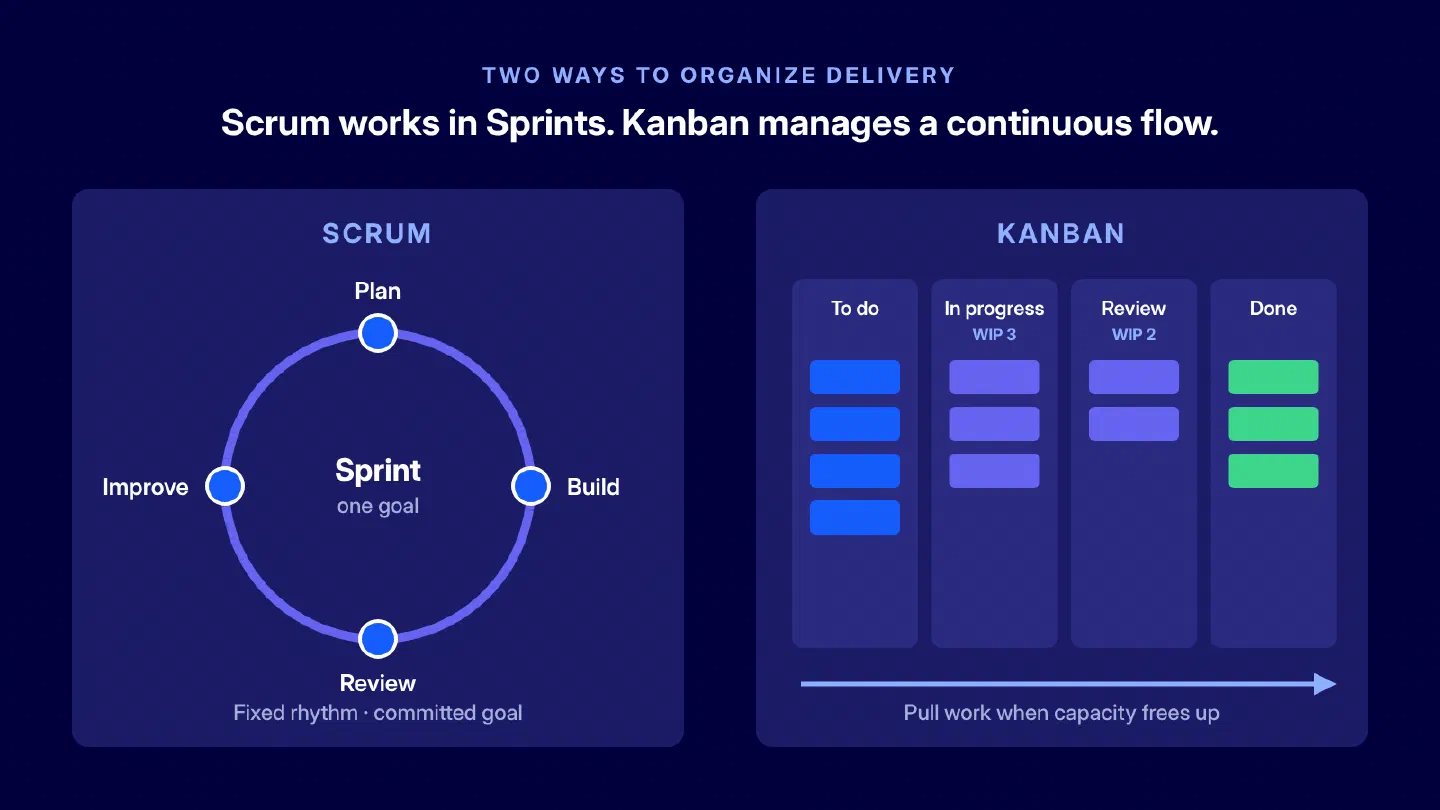
This distinction shapes how each method handles planning, work selection, commitments, change, and measurement. The table below compares those decision points in more detail.
| Decision point | Scrum | Kanban |
|---|---|---|
| Operating rhythm | Fixed-length Sprints, with planning, daily inspection, review, and retrospective | Continuous flow; review and replenishment cadence is set by the team |
| Work selection | Developers select work for a Sprint in support of a Sprint Goal | New work is pulled when the workflow has capacity under its WIP control |
| Changes to priorities | The plan can change, but changes must not endanger the Sprint Goal | Priorities can be revisited as work is replenished, under explicit policies |
| Roles | Product Owner, Scrum Master, Developers are defined accountabilities | No prescribed roles; existing responsibilities can remain |
| Constraint to protect | A coherent Sprint Goal and a usable Increment | Explicit workflow policies and control of work in progress |
| Useful evidence | Goal progress, usable increments, stakeholder feedback, quality, and flow within the Sprint | WIP, throughput, work-item age, cycle time, and service level expectation |
| Usually worth testing when | Work can be grouped around a product objective and a review rhythm adds value | Work arrives continuously or interruptions make Sprint goals unstable |
Read this Kanban vs Scrum comparison as a set of working choices, not a meeting-count contest. Scrum does not require a team to hold a release until the Sprint Review, and Kanban does not prevent quarterly planning or scheduled customer reviews. Ask which commitment needs protection: the near-term product goal, or the capacity of a service that must respond as requests arrive.
The real decision is the shape of your work
Two engineering teams can sit in the same company and still have very different delivery problems. A billing product team may have enough control over its backlog to build and review a self-service change every two weeks. The platform team that supports it may spend those same weeks handling access requests, failed deployments, incident follow-up, and planned reliability work. Applying one planning rule to both teams makes reporting consistent on paper; it does little for either team if their intake behaves differently.
For the product team, a Sprint Goal can protect an outcome such as “customers can update a payment method without support.” For the platform team, a fixed Sprint plan may be repeatedly displaced by urgent requests. Google’s SRE guidance on on-call work describes production events that can take priority over project work; that is a useful reminder that some interruptions are part of the service, not evidence of poor discipline.
The easiest way to avoid a theoretical argument about Scrum or Kanban is to look at the last few weeks of tickets. Count what was planned, what arrived afterward, and what genuinely needed immediate attention. Then check size and dependencies. An access fix that takes an hour and an architecture change that takes weeks should not disappear into the same average cycle-time number. The team may need separate classes of work before it needs a new method.
The comparison below shows why two teams in the same organization may need different workflow controls. Product work can often be shaped around planning boundaries, while service work may arrive continuously.
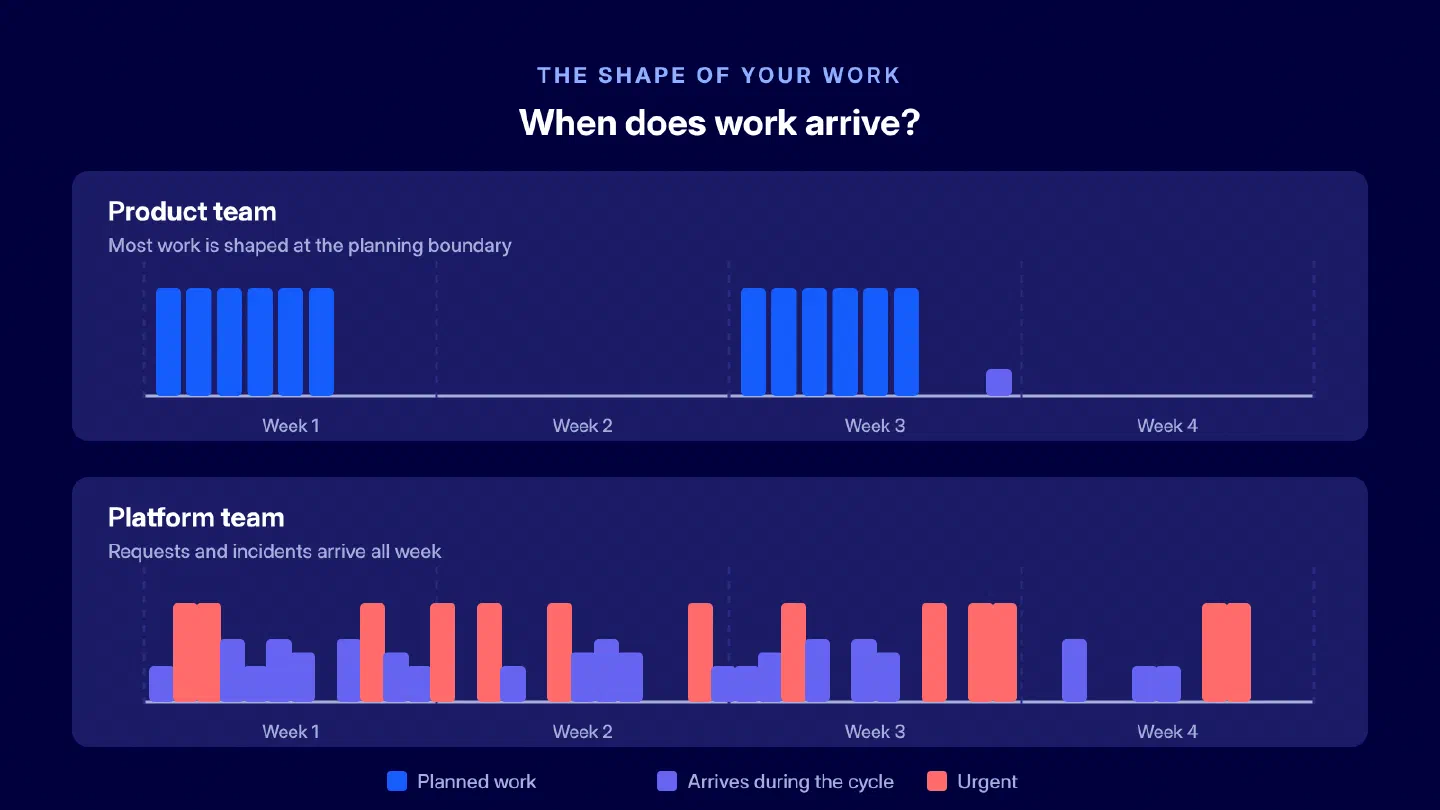
Work arrival is only the first signal. The matrix below also considers interruptions, item size, stakeholder rhythm, dependencies, planning horizon, and the team’s main delivery problem.
The workflow-shape matrix below is a discussion tool, not a validated industry benchmark. Put each dimension in the column that best matches your team’s recent work; a mixed row means you need to investigate, not force a score.
| What to inspect | Scrum-leaning signal | Kanban-leaning signal |
|---|---|---|
| Work arrival | Most work can be shaped before a planning boundary | Important work arrives throughout the week |
| Interruptions | Urgent requests are rare or handled by a protected rotation | Interruptions are frequent and legitimately time-sensitive |
| Item size | Work can usually be sliced into a usable Sprint increment | Sizes vary widely, including small operational requests |
| Stakeholder rhythm | A recurring review helps decide what to build next | Stakeholders need response times and status continuously |
| Dependencies | The team can coordinate around one near-term product goal | The team often waits on multiple services or external owners |
| Planning horizon | A short-term objective remains relevant through the Sprint | Priorities change before a Sprint ends |
| Main pain today | Weak focus or late product feedback | Queues, aging work, too much WIP, or unpredictable response time |
Treat the matrix as a prompt for discussion, not a team-type rule. A platform team can run Scrum if an incident rotation protects its Sprint Goal; a product team can use Kanban if small changes are released and reprioritized continuously. The useful finding is the constraint to test next, whether that is interruptions, item size, review capacity, or the way work is admitted.
When Scrum is the better starting point
Scrum is worth testing when the team can turn a product objective into a usable increment within a Sprint and the people at the review can make decisions about what comes next. Those conditions matter more than whether the calendar already contains the right ceremonies. The Product Owner must be able to make trade-offs, Developers need room to finish the work, and stakeholders need to see a working result rather than a status slide.
Take a payments team replacing a manual refund workflow. A two-week goal might be to enable support agents to issue a partial refund with an audit trail. The team can change implementation details during the Sprint and still preserve that outcome. At the review, support can test the workflow, identify missing exception cases, and influence the next slice. The value of Scrum here is the repeated loop between a concrete product result and informed feedback.
Watch what happens when every Sprint fills with unrelated tickets and the goal repeatedly yields to urgent work. Before replacing Scrum, find out whether the team has an intake problem, work items too large to finish, product decisions that arrive late, or dependencies outside its control. A board with continuous-flow columns will display those problems, but it will not resolve them on its own.
When Kanban is the better starting point
Kanban is often easier to operate when work arrives throughout the week and not every request deserves the same response time. That is common in platform services, maintenance, developer enablement, and support. The team still plans; it just makes a different decision explicit: what can be pulled now, given the work already underway and the service expectations attached to it?
Imagine a platform team with six items in review, two waiting for security approval, and several new deployment requests. A Kanban system makes “ready to pull,” “in progress,” “review,” and “blocked” meaningful states, then sets a policy for how much work can be active at once. The team can decide to finish older reviews before starting another migration task. It can also distinguish an urgent production incident from a routine request without allowing every stakeholder to mark their item urgent.
If the board fills up but nobody agrees when to stop starting, when an item is ready to move, or which aging item needs help, the team has visualized its queue without managing it. The Kanban Guide defines no specific roles or recurring events, but it does require teams to manage work actively under explicit policies. That distinction matters in Kanban versus Scrum evaluations that focus too heavily on meeting load.
Measure the workflow, not adherence to a label
The Kanban Guide identifies four required flow metrics. They should earn their place in the team’s conversation: an aging item might need an owner, rising WIP might call for a pause on new starts, and a longer cycle-time tail might change what the team can credibly promise. A service level expectation (SLE) is related but distinct. It states a time period and probability based on historical cycle time; it is not a fifth required flow metric.
| Signal | What it tells you | A useful management question |
|---|---|---|
| Work in progress (WIP) | How many started items are not finished | Is the team starting more than it can finish? |
| Throughput | How many items finish per unit of time | Is the delivery rate stable for comparable work? |
| Work-item age | How long a current item has been in progress | Which active items need attention before they miss the SLE? |
| Cycle time | How long completed items took from start to finish | Has the typical time or its spread changed? |
| SLE | A forecast such as “85% of items finish within eight days” | Is today’s aging work approaching an agreed risk threshold? |
The table defines what each signal means. The work item age view below shows how those signals become actionable by revealing which active items are aging in each workflow stage.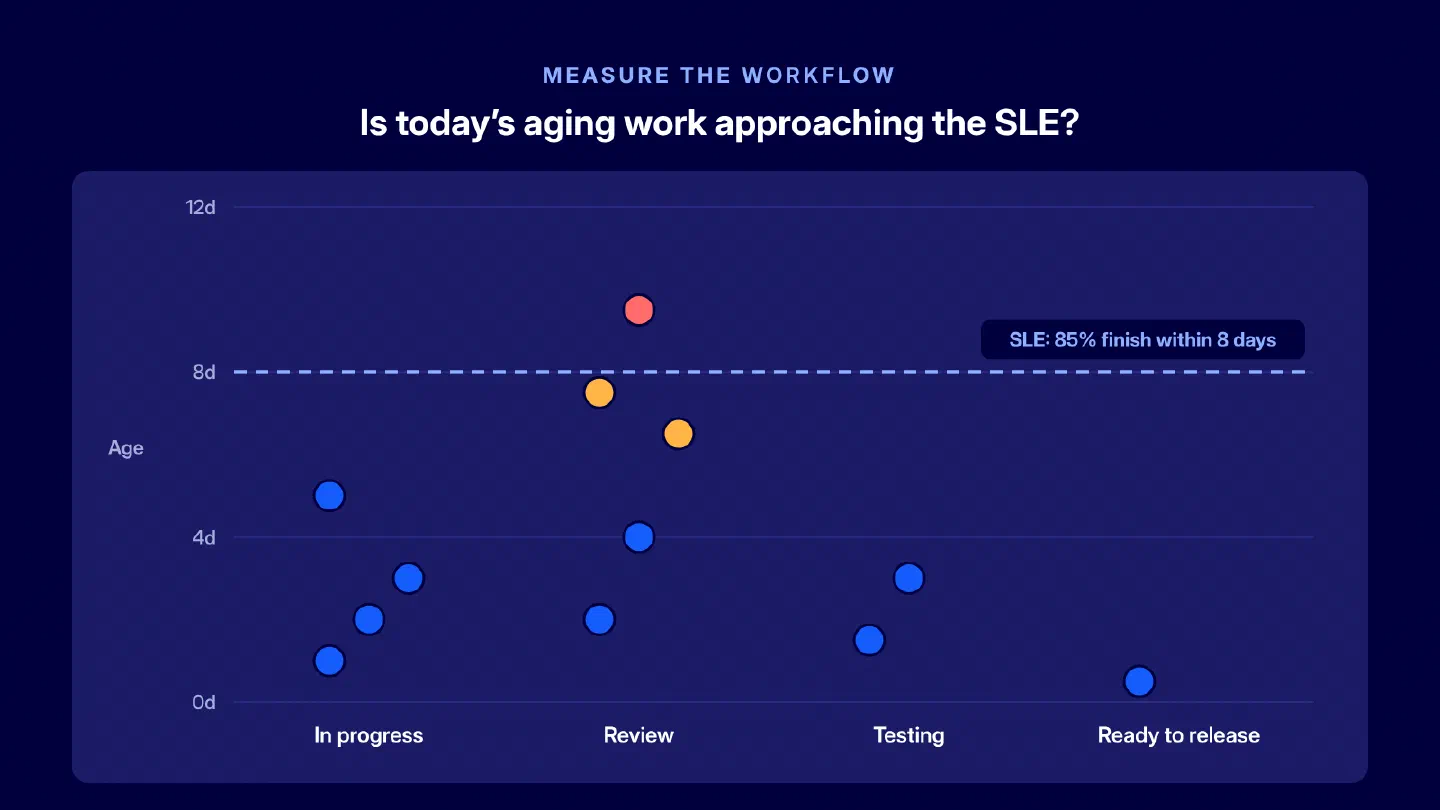
Here, the oldest items in review deserve attention even if the overall median cycle time is improving.
Suppose the median cycle time improves, yet several customer-facing requests take twice as long as before. Reporting only the median would make the change look successful while hiding the service problem. Define the start and finish points consistently, separate unlike work such as bug fixes and migrations, and look at the slow tail as well as the typical item.
For a Scrum team, the share of story points closed says little on its own about the value delivered. At the review, look at the Sprint Goal, the usable increment, what stakeholders learned, and whether quality held. Do not wait until the end of the Sprint to notice a review queue: work-item age can reveal a likely miss while there is still time to respond. Velocity can help the same team make a local plan, but differences in point scales and work mix make it a poor way to rank teams.
DORA’s guidance on choosing measurement frameworks makes the broader point that a team should choose measures that fit its organizational goals and can guide improvement. For this Scrum vs Kanban comparison, that means checking whether the chosen process helps the team deliver valuable work reliably, rather than rewarding perfect compliance with a ceremony or board policy.
Kanban vs Scrum pros and cons in practice
| Option | Advantage when it fits | Cost when it does not |
|---|---|---|
| Scrum | Protects a near-term product goal and creates regular inspection with stakeholders | Sprint plans become performative if legitimate urgent work constantly replaces planned work |
| Kanban | Makes queues, aging, and capacity visible as work arrives | Continuous reprioritization can crowd out strategic work without explicit policies and review cadence |
| Scrum with Kanban practices | Keeps the Sprint Goal while exposing WIP and flow constraints inside the Sprint | Extra rules can become process overhead if no specific bottleneck is being addressed |
A tidy Sprint board can mask weak delivery, while continuous flow can crowd out strategic work. Judge both methods by what gets delayed when urgent demand arrives.
Common Scrum and Kanban Myths: True or False?
Misconceptions often make teams compare methodology labels instead of the conditions in which work is delivered. The table below separates common claims from what Scrum and Kanban actually require.
| Claim | Verdict | What is actually true |
|---|---|---|
| Scrum prevents teams from changing anything during a Sprint. | False | The Sprint Goal should remain stable, but scope can be clarified and renegotiated as the team learns more. |
| Kanban means accepting every new request immediately. | False | Explicit policies and WIP limits determine when new work can be pulled. Urgent requests should follow a defined policy rather than bypass the system. |
| Velocity measures a Scrum team’s productivity. | False | Velocity is a local planning aid. It should not be used to rank teams or replace evidence about outcomes, quality, and Sprint Goal success. |
| Kanban has no planning, commitments, or deadlines. | False | Kanban teams still plan capacity and priorities. Historical cycle time and service level expectations can support delivery forecasts with stated probabilities. |
| Using a board means a team is practicing Kanban. | False | A board only visualizes work. Kanban also requires a defined workflow, explicit policies, active WIP control, and continuous improvement. |
| Scrum is for product teams, while Kanban is only for support teams. | It depends | The better fit depends on work arrival, interruptions, item size, feedback cadence, and the constraint the team needs to protect, not the team’s label. |
The practical question is not which framework is more correct, but which constraint the team needs to manage. Once the misconception is removed, teams can combine practices deliberately, for example by protecting a Sprint Goal while limiting WIP in review.
Can a team combine them?
Yes. Kanban practices can complement Scrum. A Scrum team can define its workflow, limit work in review, watch item age, and use cycle-time history in Sprint planning. It still retains the Scrum accountabilities, events, and commitments. A team that uses a few Scrum-like reviews alongside a Kanban system can also benefit, but calling every mixture “Scrumban” does not explain how it works.
Start with a specific failure. When a review queue puts the Sprint Goal at risk, a review WIP policy gives the team a reason to finish or unblock work before opening more of it; work-item age will show whether that helped. When a service team responds quickly to requests but postpones reliability work, a scheduled portfolio review can protect those investments. The hybrid has value if a new practice changes one of those decisions, not because the team has collected more ceremonies.
A seven-question scorecard for your team
Use the following worksheet with the team, product owner or service owner, and a delivery stakeholder. Mark S when the first answer is closer to reality, K when the second is, and ? when the evidence is missing. The marks guide a conversation, not an automatic verdict.
- Can most upcoming work be shaped before a short planning period (S), or does important work arrive continuously (K)?
- Can urgent requests be isolated without losing the near-term objective (S), or must the whole team respond frequently (K)?
- Are items generally small enough to form a usable increment within a Sprint (S), or do sizes and service classes vary widely (K)?
- Does a recurring stakeholder review materially improve product direction (S), or is continuous service feedback more important (K)?
- Is weak focus the main problem (S), or is work aging in queues despite everyone being busy (K)?
- Can the team maintain a meaningful Sprint Goal through the period (S), or does that goal regularly become irrelevant (K)?
- Is the key promise a product outcome for the next review (S), or a dependable response time across ongoing requests (K)?
Split answers are worth investigating rather than averaging into a verdict. The product team might need a dedicated interrupt rotation, while the platform team may need protected capacity for larger engineering investments. The difference between Kanban and Scrum becomes useful once the team can say which part of its work needs a different rule.
Test method fit with a four-to-six-week experiment
Give a process change a testable purpose. If too much work waits in review, for example, record the current queue and item ages before adding a WIP control. Four to six weeks usually provides several observations for teams working in weekly or two-week rhythms; a longer planning or service cycle needs more time. Keep the definition of a work item stable during the test, or you may mistake a reporting change for an improvement.
The visual below turns the pilot into four steps: establish a baseline, change one constraint, observe several cycles, and decide what to do next.
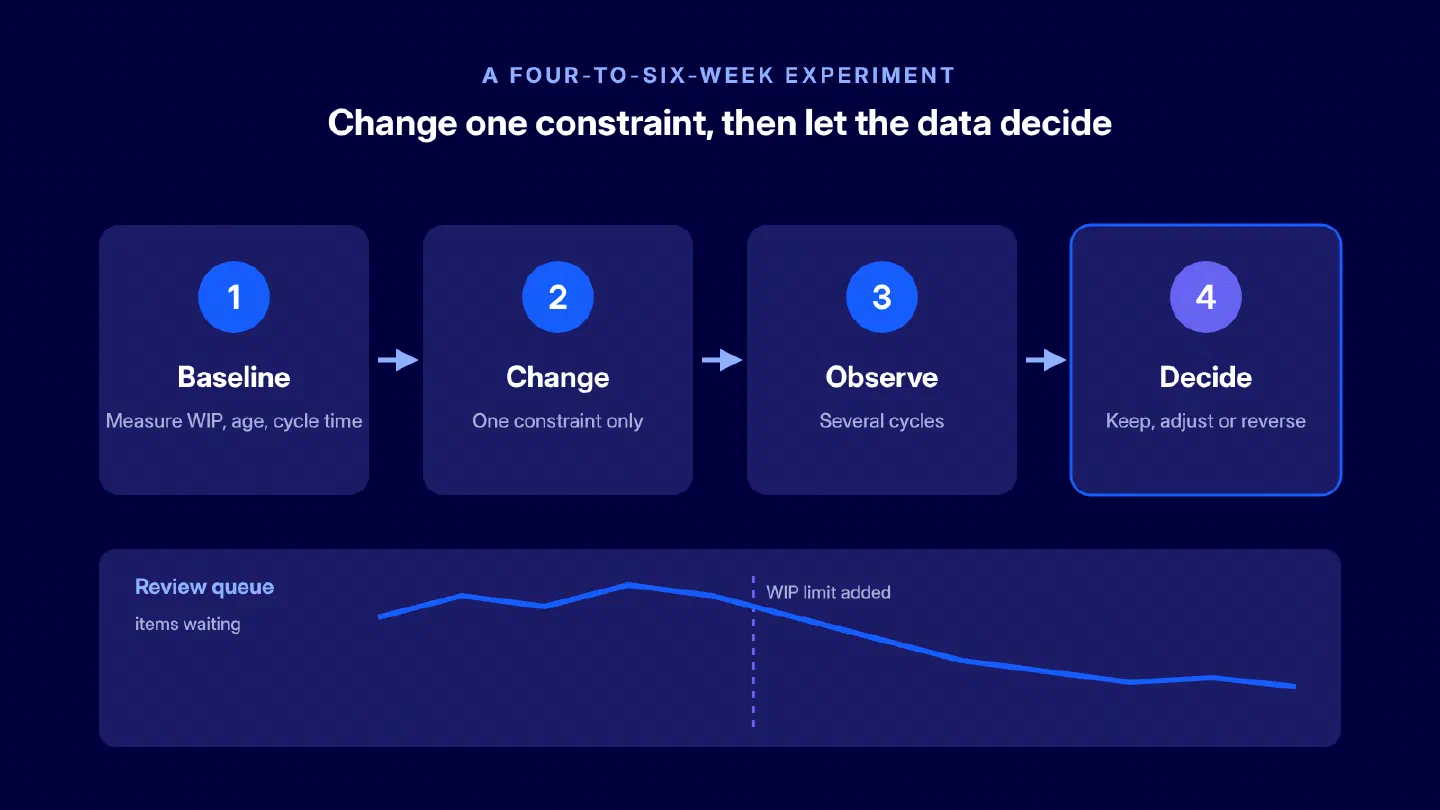
The table below translates the same sequence into the actions and evidence required at each stage.
| Stage | What the team does | Evidence to review |
|---|---|---|
| Baseline | Examine recent work by type; define start and finish; note WIP, age, cycle time, throughput, blocked time, goal success, and spillover where relevant | Variation and recurring delays, not just averages |
| Change one constraint | Examples: protect a Sprint Goal with an interrupt rotation, or introduce a review WIP control | Whether the intended policy was actually used |
| Observe several cycles | Review active aging items weekly and completed items at the end of each cycle | Has the bottleneck moved, and are quality and service outcomes intact? |
| Decide | Keep, adjust, or reverse the change | Predictability, stakeholder value, and sustainability together |
The trade-off matters as much as the headline metric. If a WIP control shortens cycle time but urgent incidents now wait longer, the service has not necessarily improved. A Scrum team might complete fewer planned tickets yet deliver a better increment after stakeholders identify the right product change. Review the business outcome alongside the flow numbers before keeping or reversing the experiment.
This is also where engineering delivery analytics can help. When a queue grows, the delivery question is not simply whether the team followed Scrum or Kanban; it is which initiative now depends on that queue, what stage is holding it up, and whether its expected completion date has moved.
How AndonPulse helps turn a workflow signal into a decision
An item-level board is useful for the team doing the work. A delivery leader has a different question: which initiative is affected, what depends on it, and is the completion estimate still believable? AndonPulse connects data from existing planning and engineering tools into initiative, project, task, and workflow-stage views. Its integrations let managers investigate delivery in the tools teams already use, without asking engineers to maintain another status report.
Consider the platform team’s review queue. In AndonPulse, a manager can move from an initiative showing delivery risk to the tasks and workflow-stage durations behind it, then check whether the delay is concentrated in review or spread across the workflow. That gives the next conversation a concrete starting point: who owns the pending reviews, which dependency needs attention, and should the team stop starting new work? After an intervention, the same view helps the manager see whether the queue and initiative outlook improve. The platform supplies context and visibility; the manager still chooses the response.
The same view can put a missed Sprint Goal in context. Was the planned feature waiting in review, displaced by urgent work, or blocked by another initiative? AndonPulse makes that distinction more visible across tools and teams. Leaders can therefore discuss the source of delay and its effect on a business commitment, instead of treating the methodology label as the diagnosis.
Final takeaway
Choose a workflow around the demand the team actually receives, and change it if the evidence says it is not working. Scrum can protect a product objective long enough to deliver and review a usable increment. Kanban can help a team handle continuous intake without losing sight of WIP, aging work, or service expectations. Many teams will borrow from both. The test is whether customers get the expected outcome and the team can spot a delivery problem early enough to do something about it.
FAQ
What are the main Kanban vs Scrum differences?
Kanban vs Scrum: which is better for software teams?
Can Scrum and Kanban be combined?
Is Kanban just a board with columns?
Can a support or SRE team use Scrum?
Which metrics belong in a Scrum vs Kanban comparison?
Does Kanban mean no planning or deadlines?
Should velocity decide whether a team uses Scrum or Kanban?
How long should a team test a new workflow?
See the decision in your own delivery data
The next debate about Kanban or Scrum will be more productive with a live delivery problem on the table. Bring an initiative and a bottleneck that managers are already trying to resolve to an AndonPulse demo. You can see how the platform connects the work across tools, where progress is slowing, and whether the delay changes the outlook for a business commitment.