Founded in 2007, Yola has served over 15 million users across 190 countries. In May 2025, NetNation acquired Yola, and Yola now operates as a product within NetNation. Eugene Gusarov, who originally championed Yola’s flagship product internally, now leads the full engineering and product org as Director of Product and Engineering.
The challenge: a compliance process with no opt-out
For most engineering organizations, R&D capitalization is a manual process by default: every engineer logs their hours daily to comply with ASC 350-40, the US accounting standard that governs how and when software development costs can be capitalized on a company’s books. And in that default model, design, QA, and PM time typically aren’t in scope at all — only developer time.
When R&D capitalization landed on Eugene’s team as a mandate, the goal from the start was to automate the process rather than carry it manually. ASC 350-40 compliance is a real financial and audit obligation: get it wrong, and the capitalization reports filed with finance are indefensible. Get it right with manual timesheets, and you build a sustained, invisible drain on every person who builds the product. He wanted a third option.
“There was nowhere to run, as they say. We had to do it.” — Eugene Gusarov
That made the question concrete: what’s the cheapest, most defensible way to implement R&D capitalization in a Kanban-native engineering team, without forcing every engineer to fill in timesheets?
It comes out to roughly $30–60K per year in pure overhead — wasted time on manual time logging. That activity should be automated at the process level. People shouldn't be doing it at all.

The math behind that estimate was straightforward: 15–30 minutes of daily time-logging per person, multiplied across the working year, translates into tens of thousands of dollars of recurring overhead, before you account for inevitable errors and the finance-side verification burden that followed every cycle. This wasn’t a one-time cost. It was an annual tax, compounding indefinitely.
Why AndonPulse — after evaluating the rest of the market
Eugene’s evaluation criteria were specific:
- Traceability: full, end-to-end traceability of capitalized work, native to the existing SDLC.
- Transparency: no black-box formulas; every calculation defensible during an audit.
- Coverage: capitalize engineering, design, and QA effort, plus PM/review activity that meets the criteria.
He worked through the leading tools first:
- Swarmia (an engineering metrics platform built around Git pull-request analysis): strong delivery insights, but its capitalization logic relies on a proprietary “Magic Formula” derived from pull-request signals — one the team couldn’t get visibility into during the evaluation. In an audit, you need to explain exactly why 2 hours were capitalized on a given task, not 50. “We use Swarmia, and they calculated it somehow” is not a defensible answer. Swarmia’s capitalization also covered engineering effort only — not design or QA. Out.
- Jellyfish (an enterprise-grade engineering intelligence platform): never responded to outreach during the evaluation window. Everything Eugene could gather suggested their typical customer runs significantly larger than his org. Out.
- AllStacks (an engineering analytics platform): same PR-centric, signal-based model as Swarmia, no design or QA capitalization, and a proprietary formula the team couldn’t get visibility into. Nothing Eugene could surface to an auditor. Out.
- WayDev (a developer analytics platform with rule-based, flow-aware tracking): the closest fit. WayDev supports task-flow tracking rather than PR magic, and its model is explainable. But the full-service tier (the only option that included a dedicated account manager, essential for a compliance rollout) required an annual contract priced above the budget for this initiative. The self-serve tier offered no dedicated support. For a financial compliance process rolled out inside a newly acquired department, that wasn’t viable.
AndonPulse was, in Eugene’s words, the last product on his list — and the one he picked.
Your solution maps directly to our needs. We can capitalize engineering, design, and QA. The math is fully transparent — because we write the rules ourselves in the platform.
The deciding factors: full coverage of design and QA, transparent math, the team configures itself, ASC 350-40-defensible traceability, end-to-end premium support, and pricing well within budget.
The solution: capitalization that rides the Kanban board
NetNation’s engineering team has spent years building disciplined Kanban hygiene. Task statuses change in real time as work moves through In Progress, Review, and other statuses on the board. AndonPulse plugs directly into that flow.
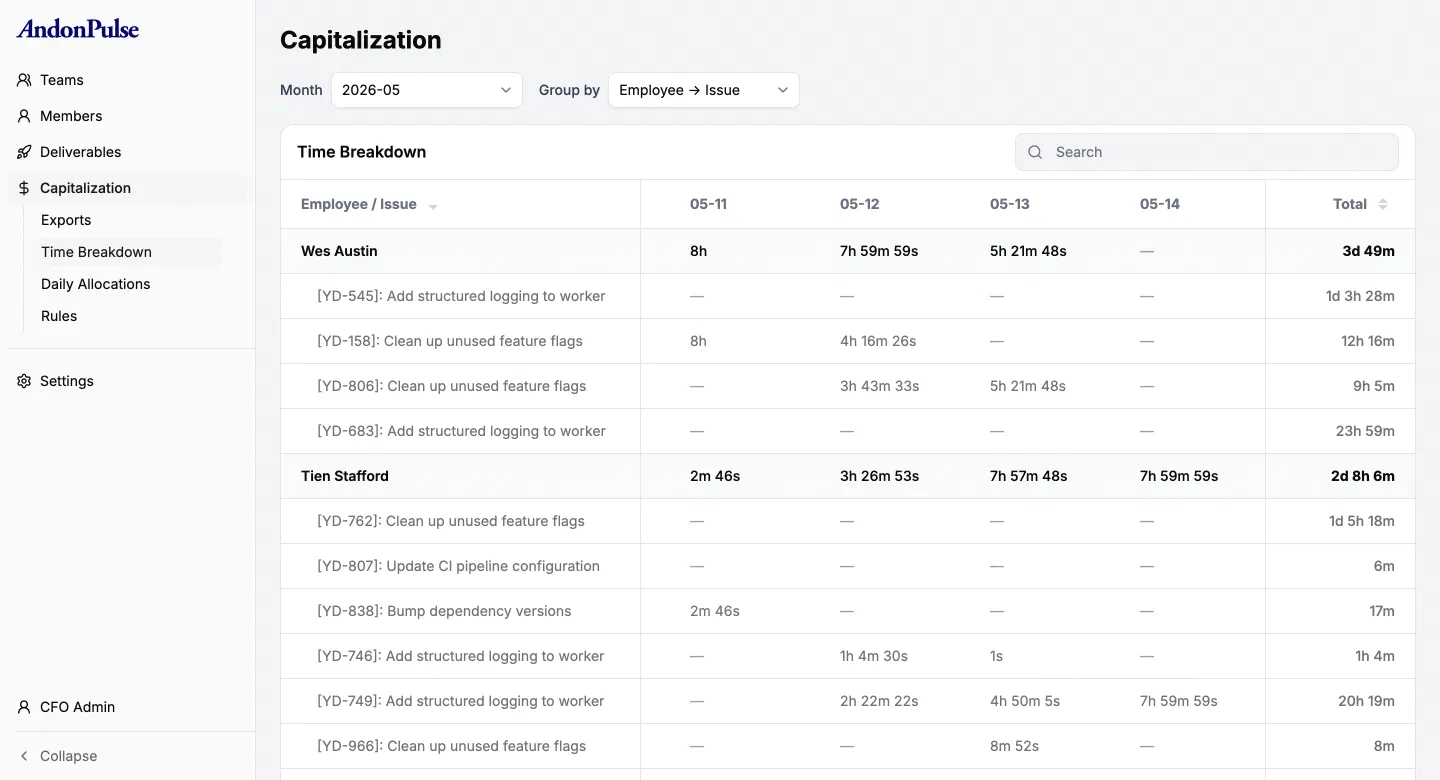
Capitalization rules are configured as status-aware policies inside the platform: when a task sits in an “active work” status, the time is tracked against that task; capitalization eligibility follows the ruleset the team writes. Engineering, design, and QA efforts are all in scope.
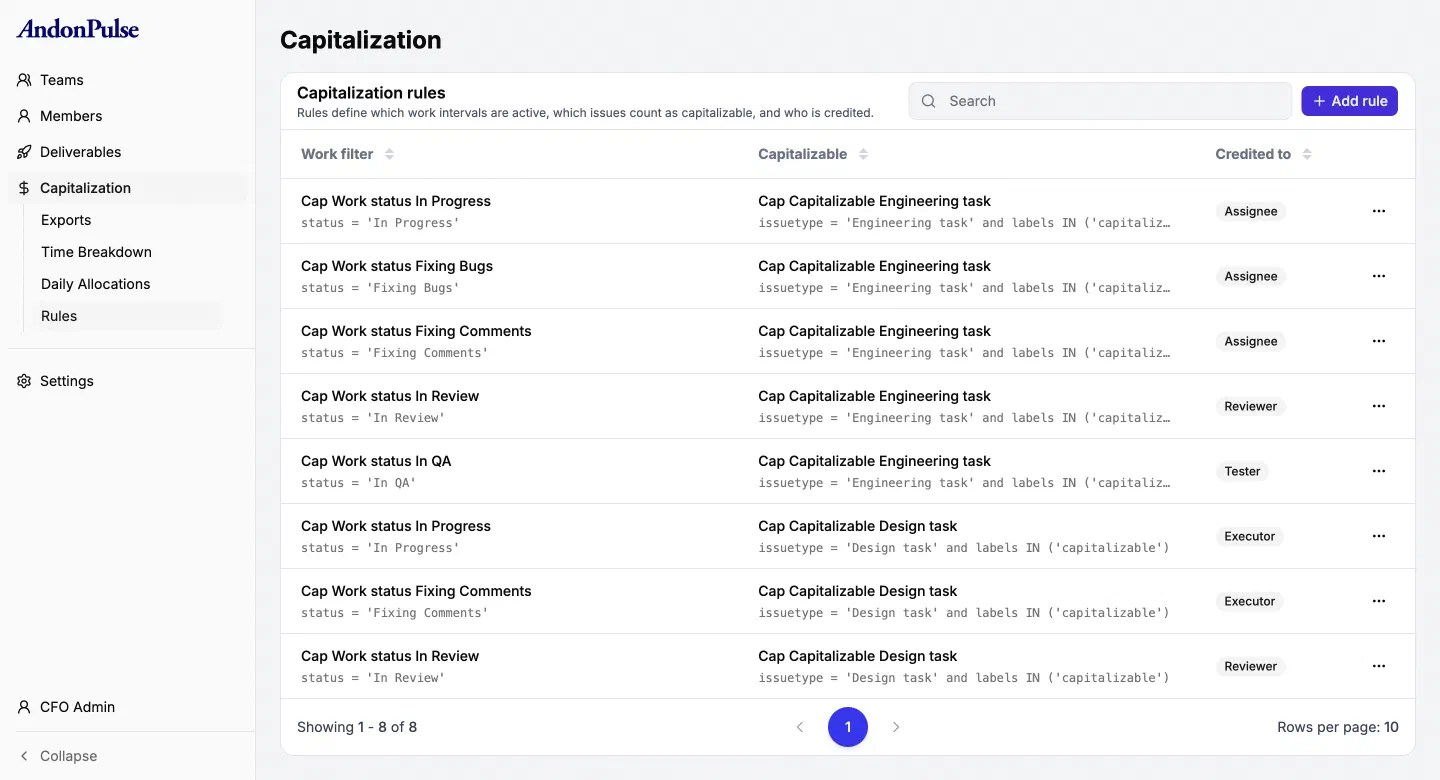
AndonPulse’s premium support team handled the full configuration: mapping the team’s specific Kanban statuses to capitalization criteria, defining per-role eligibility, and tying every rule to ASC 350-40 defensibility. Eugene’s team showed up with a working system.
It wasn't hard at all — your premium support did it all for us.
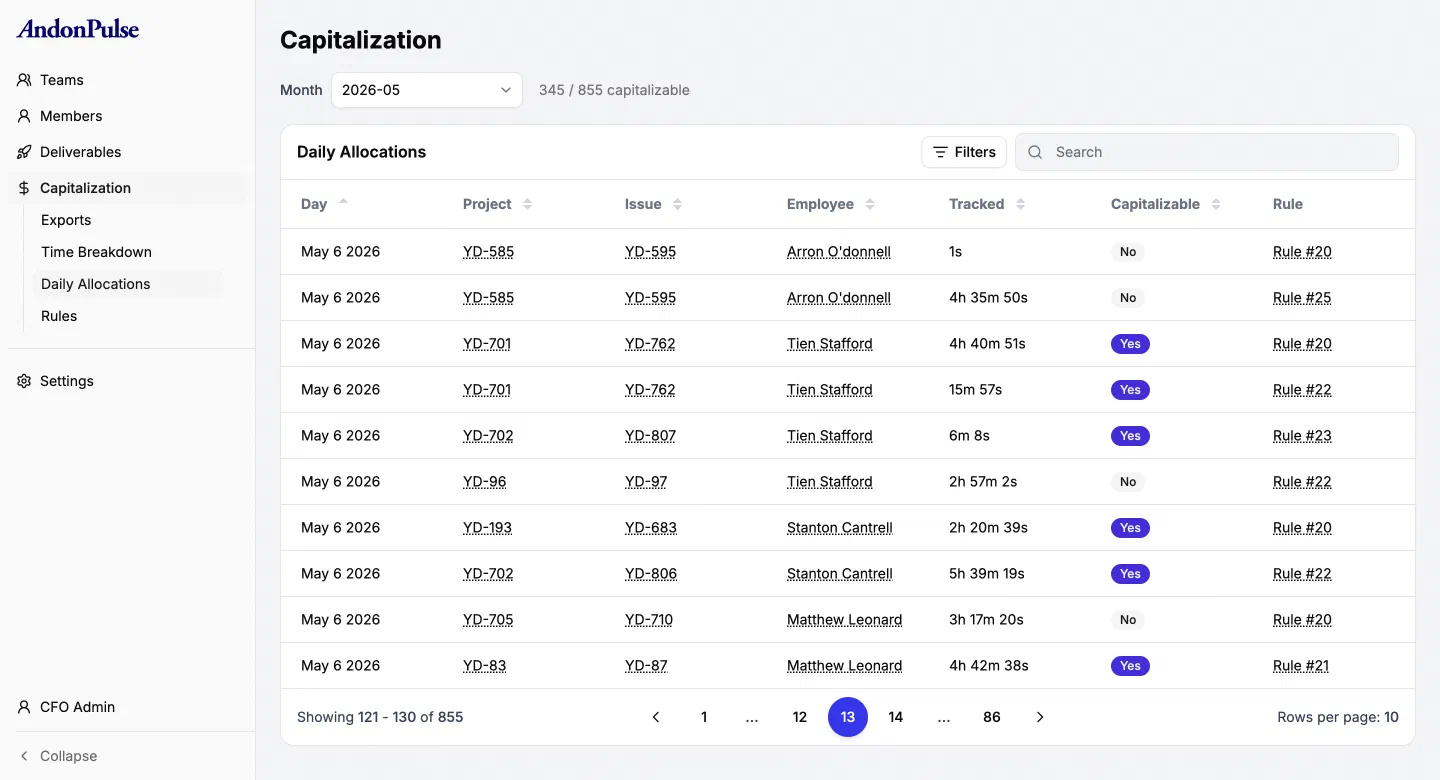
AndonPulse generates the capitalization report as a finished package, ready to hand to finance — without engineers, designers, or QA needing to track their own hours.
Results: 15-minute report, zero engineer time-logging
After the first reporting cycle:
- ~15 minutes to produce a full capitalization report — excluding the one-time template configuration. The template AndonPulse provides outputs not just hours-by-person-by-task, but the dollar amount capitalized once the cost-per-person is entered.
- Engineering time capitalized within the standard industry benchmark for R&D capitalization, on the first report.
- Zero engineer, designer, or QA time-logging required to produce the report.
- ~$30–60K/year in avoided manual time-logging overhead — every year going forward (Eugene’s estimate).
Preparing the first report — excluding the one-time template setup — took me about 15 minutes.
The finance team’s confidence came from transparency, not from black-box trust:
“We had a lot of detailed conversations about how it all works, how it’s calculated, how it maps to accounting standards. It’s super transparent for them. No questions.” — Eugene Gusarov
Time-to-value
Yola’s team moved from “no R&D capitalization process” to a finance-ready first report inside the AndonPulse trial window, a single quarter from initiative to delivered artifact. The first proper report was produced before the trial closed.
What’s next: from R&D capitalization to delivery metrics
Making the Kanban board the source of truth for financial reporting raised the bar on board accuracy across the team — and that accurate data opened a clear next opportunity: using the same source of truth to understand and improve delivery itself.
The trigger to invest in delivery metrics was actually the rollout of R&D capitalization itself.
With capitalization running cleanly, NetNation is planning to expand its AndonPulse use into delivery analytics: cycle time, waiting time, and blocker analysis. The goal is the part of delivery that matters most:
“The biggest secret of Delivery is that most of the time, the work is waiting. We want to see, in numbers, how well we’re optimizing that idle time.” — Eugene Gusarov